Redmi Note 15 4G vs Vivo Y32t
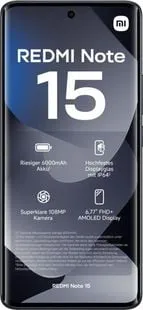

The Redmi Note 15 4G (2025) runs on the MediaTek Helio G100 Ultra, while the Vivo Y32t (2022) runs on the MediaTek Helio P70 (). By overall MobileRank rating, the Redmi Note 15 4G leads — 37/100 vs 11/100 (a 26-point difference). Key differences: the Redmi Note 15 4G has the bigger battery (6000 mAh vs 5000); the main camera is 108 MP vs 13 MP; the Redmi Note 15 4G has NFC for contactless payments, the Vivo Y32t doesn't.
Redmi Note 15 4G
Vivo Y32t
- Bigger battery: 6000 vs 5000 mAh
- Better main camera: 108MP vs 13MP
- Better camera (40/100 vs 0/100)
- Longer battery life (48/100 vs 36/100)
- Better display (100/100 vs 0/100)
- Better value for money (96/100 vs 55/100)
- Lighter: 179g vs 183g
- Better design/ergonomics (76/100 vs 71/100)
Comparing the Redmi Note 15 4G vs the Vivo Y32t, the Redmi Note 15 4G scores 26 points higher (37/100 vs 11/100). In the "camera" category, the Redmi Note 15 4G leads (40/100 vs 0/100). In the "battery" category, the Redmi Note 15 4G leads (48/100 vs 36/100). In the "value for money" category, the Redmi Note 15 4G leads (96/100 vs 55/100). In the "performance" category, both devices are on the same level — 0/100. In the "display" category, the Redmi Note 15 4G significantly outperforms the Vivo Y32t (100/100 vs 0/100). In the "camera" category, the Redmi Note 15 4G significantly outperforms the Vivo Y32t (40/100 vs 0/100). In the "battery" category, the Redmi Note 15 4G is a bit better (48/100 vs 36/100). In the "design" category, the Vivo Y32t is a bit better (76/100 vs 71/100). In the "value for money" category, the Redmi Note 15 4G significantly outperforms the Vivo Y32t (96/100 vs 55/100).
| Specification | Redmi Note 15 4G | Vivo Y32t | |
|---|---|---|---|
| Processor | MediaTek Helio G100 Ultra | MediaTek Helio P70 () | |
| AnTuTu | 408000 | — | |
| Geekbench Single | 760 | — | |
| Geekbench Multi | 1890 | — | |
| Display | 6.8" AMOLED | 6.5" LCD IPS | |
| Resolution | 1080x2392 | 720x1600 | |
| Refresh rate | 120 Hz | — | |
| Battery | 6000 mAh | 5000 mAh | |
| Charging | 33W | — | |
| Main camera | 108 MP | 13 MP | |
| Front camera | 20 MP | 8 MP | |
| RAM | 6GB / 8GB | — | |
| Storage | 128GB / 256GB / 512GB | 128GB / 256GB | |
| OS | Android 15, up to 4 major Android upgrades, HyperOS 2 | Android 11 Red Velvet Cake | |
| Brightness (peak) | 3200 nits | — | |
| NFC | yes | no | |
| Protection | IP64 | — | |
| Dimensions | 164.0×75.4×7.9 mm | 164.0×75.2×8.3 mm | |
| Weight | 183 g | 179 g | |
| Price | $199 | — |
Redmi Note 15 4G
- Main: 108MP f/f/1.7
- Front: 20MP
Vivo Y32t
- Main: 13MP
- Front: 8MP
Redmi Note 15 4G
- 6.8" AMOLED
- Resolution: 1080x2392
- Refresh rate: 120 Hz
Vivo Y32t
- 6.5" LCD IPS
- Resolution: 720x1600
- Refresh rate: —
Redmi Note 15 4G
- 6000 mAh
- Wired: 33W
- No wireless charging
Vivo Y32t
- 5000 mAh
- No wireless charging
Vivo Y32t
Price unknownperformance
In the "performance" category, both devices are on the same level — 0/100.
display
In the "display" category, the Redmi Note 15 4G significantly outperforms the Vivo Y32t (100/100 vs 0/100).
camera
In the "camera" category, the Redmi Note 15 4G significantly outperforms the Vivo Y32t (40/100 vs 0/100).
battery
In the "battery" category, the Redmi Note 15 4G is a bit better (48/100 vs 36/100).
design
In the "design" category, the Vivo Y32t is a bit better (76/100 vs 71/100).
value for money
In the "value for money" category, the Redmi Note 15 4G significantly outperforms the Vivo Y32t (96/100 vs 55/100).
Which is better: the Redmi Note 15 4G or the Vivo Y32t?
The Redmi Note 15 4G significantly outperforms the Vivo Y32t by 26 points (37/100 vs 11/100).
What is the rating of the Redmi Note 15 4G and the Vivo Y32t?
The Redmi Note 15 4G has a MobileRank rating of 37/100, the Vivo Y32t — 11/100.
Which has the better camera: the Redmi Note 15 4G or the Vivo Y32t?
The Redmi Note 15 4G leads on camera score (40/100 vs 0/100).
Should you choose the Redmi Note 15 4G over the Vivo Y32t?
The Redmi Note 15 4G is a better fit for budget-conscious buyers. The Vivo Y32t is a better fit for everyday use.